Welcome to Performing Arts


Welcome to Performing Arts
The inspiration and power of the performing arts play a vital role in enabling our children and young people to enhance their creative talent and develop their artistic skills.
The expressive and performing arts play a critical role in shaping our sense of our personal, social, and cultural identity. Learning in the expressive arts also plays an important role in enabling young people to experience the vitality of culture locally, nationally, and globally.
Learning in, through and about the expressive arts enables children and young people to:

Meet the Staff
Music & Drama
Mr Ballantyne – Curriculum Leader
Miss Clark – Drama Teacher
Mrs Lane – Music Teacher
Ms Holland – Music Teacher
Mr McKain – Music Teacher
Instructors
Miss Nelson – Viola/Violin
Mr Cameron – Double Bass
Mr Ferries – Guitar
Mr Bonnar – Drumkit (Wednesday)
Mr Jeans – Drumkit (Friday)
Ms Taxidou – Piano/Keyboard
Ms Sayhouni – Singing
Mr Ross – Brass
Mr Rennard – Woodwind
Ms Jablonska – Cello
MUSIC
Music is a universal language that is an integral part of the school community at RHS. Pupils have access to a wide range of musical experiences through both the formal curriculum and a diverse mix of extra-curricular opportunities. Taking part in musical activities enriches the lives of learners and can lead to a sense of accomplishment, helping to equip them with a range of fundamental skills for life, learning and work.

BGE
All S1 and S2 pupils receive 1 hour of Music per week. Courses are aligned to the BGE Expressive Arts, Literacy and Health and Wellbeing benchmarks and offer opportunities to develop musical skills through a variety of practical based activities. Pupils listen, perform, and compose music from a wide variety of genres including World Music, Popular Music and Music for Film or Media. They develop skills on typical classroom instruments such as keyboard, guitar, percussion, and voice whilst also learning about different forms of musical notation. Through listening activities, pupils develop their musical vocabulary to accurately describe and analyse what they hear. Composition activities provide an opportunity to explore the creative process and to make links with Music Technology.
Music Technology N5
This is a dynamic and practical course in which students will have the opportunity to develop a range of skills and techniques relating to the creative use of music technology hardware and software to capture and manipulate audio. Through the completion of two practical assignments, pupils will learn about microphone placement techniques, setting input gain, monitoring levels, overdubbing, and editing tracks. They will also learn how to use effects such as equalisation, compression, and reverb along with mixing and mastering techniques. Typical assignment tasks might include a radio broadcast or sound design for a short film clip, computer game or audiobook. The assignments are worth 35% each. Alongside the practical assignments, pupils will develop knowledge and understanding of 20th and 21st century styles and genres of music. They develop an understanding of aspects of the music industry, including a basic awareness of the implications of intellectual property rights. This part of the course is worth 30% and is assessed by a question paper.
National 4/5
At National 5 level pupils demonstrate their performing skills by presenting a prepared programme of music to an examiner on two different instruments, or one instrument and voice. Pupils must perform a minimum of two pieces on each at Grade 3 level or above. At National 4, the standard is Grade 2 or above and the Added Value Unit is internally assessed. Performance is worth 50% of the overall mark. Pupils will be encouraged to improvise and compose their own music in a range of ways and techniques, using music software and instrument. Pupils will learn about a variety of different musical styles and their social context, expanding their knowledge and understanding of musical concepts and features. They will also have opportunities to be involved in various events and concerts as well as smaller classroom performances. It is an enjoyable and practical approach to build instrumental and/or vocal skills, along with skills in IT, creativity, research, and presentations.
Higher
The senior school courses build on work in S3/S4 and consists of three elements; Performing, Composing and Understanding Music. Performance is worth 50% of the course award, and candidates must perform a minimum of two pieces on each instrument at Grade 4 or above. Composing, accounts for 15% of the course and Understanding Music, 35%. Learners must perform a programme of music, compose an original piece of music and identify a range of musical styles and concepts.
Advanced Higher
This course requires an A/B pass at Higher Music and explores the three units from Higher in more depth. Additionally, pupils may opt for a Composition folio option instead of presentation on a second instrument. Course weightings are the same as Higher and candidates must perform pieces which are the equivalent of Grade 4 or above.
RHS Extra-Curricular Clubs list
Monday
| Guitar Ensemble | 1.20pm | MU1 |
| S1/S2 Band | 1.20pm | MU3 |
Tuesday
|
RHS Student Choir – The Shirley Tempos |
1.20pm |
MU1 |
|
Senior Band |
1.20pm |
MU3 |
Wednesday
|
RHS Concert Band |
1.20pm |
Drama Studio |
|
S2/S3 Band |
1.20pm |
MU3 |
| String Ensemble | 1.20pm |
MU1 |
Thursday
|
Fiddle Group |
1.20pm |
Drama Classroom |
|
Show Choir |
3.30 – 4.30pm |
MU2 |
DRAMA
Drama Education enables students to develop their understanding of the world, relationships, culture, and society. It is a mirror for real life. In Drama, students work collaboratively with others, explore moral and ethical issues, and use their skills to communicate with an audience. Through Drama, students learn to become confident individuals, successful learners, responsible citizens, and effective contributors.
The Drama Department
The Drama department comprises two specialist teachers within the Faculty.
We offer a wide range of opportunities for performance and activities.
A wide range of SQA National Qualification courses are on offer in Drama including:
BGE
In S1 & 2 Drama classes you will build on skills such as, mime and movement, storytelling, improvisation, using scripts, role play, movement and voice and responding to stimuli. You will explore different genre, devised work and scripted work. A fun and creative way to explore your learning.
Should I choose Drama in S3?
The Drama course is for anyone interested in developing their creative skills. You don’t have to be aiming for an acting career! Choosing Drama is an excellent way to build confidence and develop personal and social skills, including working in a group or as a team. You will learn essential skills for life including creativity, collaboration, communication, negotiation and problem solving. Drama improves your ability to express yourself through a range of Drama activities and tasks, including performances. Drama is an exciting, enjoyable and rewarding course which builds confidence and prepares you for life after school! You learn to be creative, communicate well, organise your thoughts and turn your ideas into action. You also learn technical skills in lighting and sound; set design and props; costume and make up. An excellent choice of course for anyone interested in working with people, the performing arts and creative industries.
What will I learn?
Drama Skills
By responding to a variety of stimuli, you will develop skills in improvisation, creating characters, devising Drama and using Drama forms and conventions. You will work with others when creating pieces of drama and apply acting skills to portray character. You will learn to evaluate your own work and the work of others.
Production Skills
You will explore production skills in set and props, costume and make up, lighting and sound. You will use your production skills and generate ideas for a production concept using a script. You learn to develop and use production skills and evaluate your own contribution.
Performance
In this unit you will prepare for, take part in and reflect on a small-scale drama performance. You will work with others to develop ideas. You will develop understanding of social and cultural influences on drama, select and apply skills and knowledge appropriate to your chosen role and carry out your chosen role effectively.
Progression
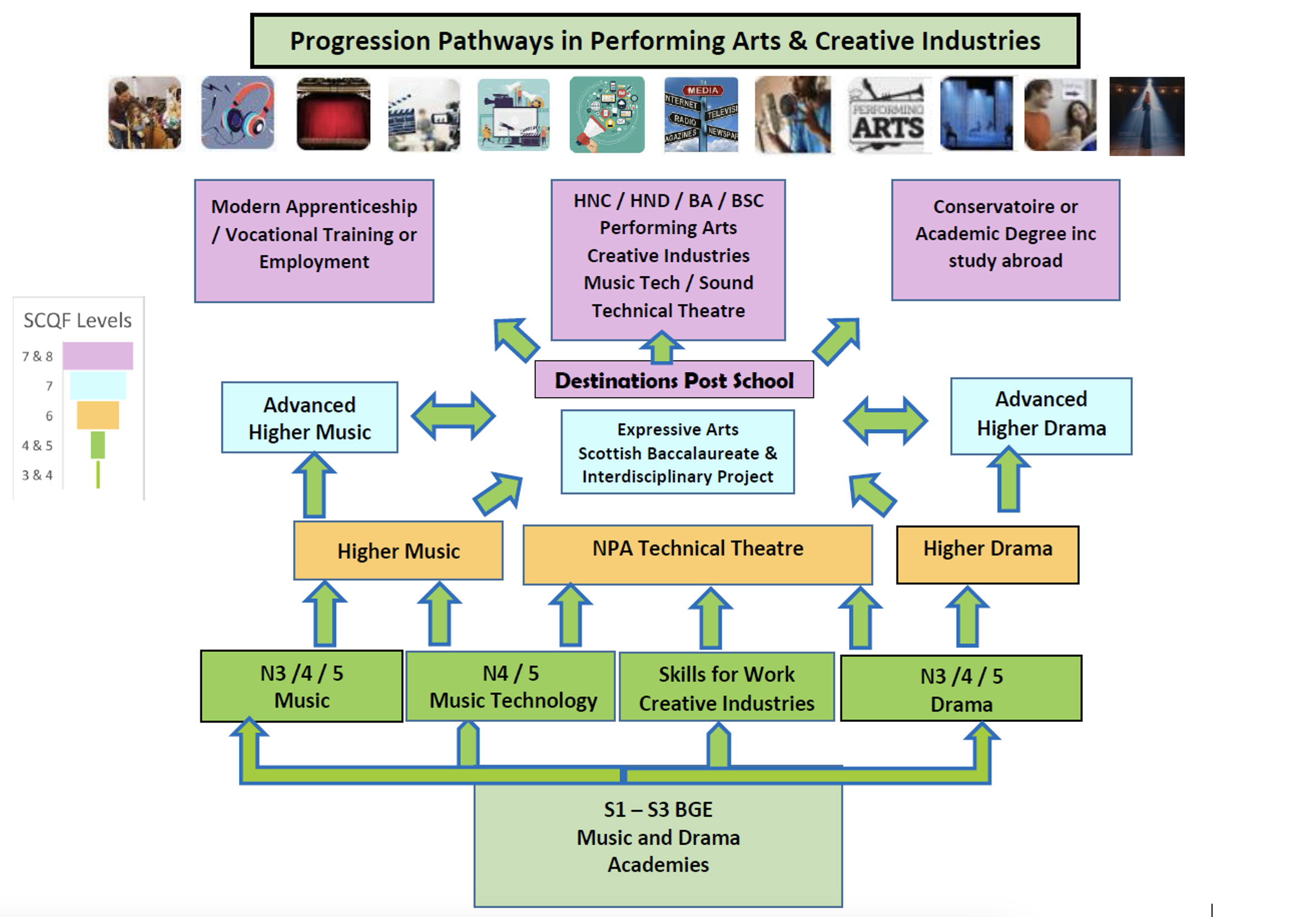
In S4; National 4 or 5 Drama. In S5 and S6; Higher Drama, Creative Industries
National 4 & 5
Should I choose Drama?
The Drama course is for anyone interested in developing their creative skills. Choosing Drama is an excellent way to build confidence and develop personal and social skills, including working in a group or as a team. You will learn essential skills for life including creativity, collaboration, communication, negotiation and problem solving. Drama improves your ability to express yourself through devising Drama and Performance. Drama is an exciting, enjoyable and rewarding course which builds confidence and prepares you for life after school. You learn to be creative, communicate well, organise your thoughts and turn your ideas into action. You also learn technical skills in lighting and sound; set design and props; costume and make up. An excellent choice of course for anyone interested in working with people, the performing arts and creative industries.
What will I learn?
Drama Skills
By responding to ideas and stimuli for drama, you will develop ideas and techniques to communicate dramatic themes. You will work with others when preparing, researching and devising pieces of drama and apply acting skills to portray character. You will learn to evaluate your own work and the work of others.
Production Skills
You will explore production roles and use your production skills by interpreting stimuli and generating ideas for a production concept. You learn to develop and use production skills and evaluate your own contribution to the dramatic context.
Performance
In this unit you will prepare for, take part in and reflect on a small-scale drama performance. You will work with others to develop ideas. You will develop understanding of social and cultural influences on drama, select and apply skills and knowledge appropriate to your chosen role and carrying out their chosen role effectively.
Progression
In S5 and S6, students can choose further study in Drama National 5 or Higher, or the Creative Industries course.
Assessment
National 4 courses are internally assessed through a Performance and coursework. National 5 is external assessment through a performance in a chosen production role (60%) and a question paper (40%).
Higher
Entry
Progression
The CfE Higher Drama NQ is accepted as a University and College entrance qualification and shares common threads with English, Media Studies and Social Studies. You will also refer to complex social and cultural influences on drama through the study of plays and playwrights. The course is recommended for students wishing to pursue a degree or further qualification in theatre, performing arts or creative industries, humanities, social sciences, humanities, and law.
The course provides opportunities for learners to develop skills creating and presenting drama. This Course focuses on the development and use of complex drama skills and production skills to present drama.
Learners will analyse and evaluate how the use of self-expression, language and movement can develop their ideas for drama. Learners will develop critical thinking skills as they investigate and develop complex drama skills.